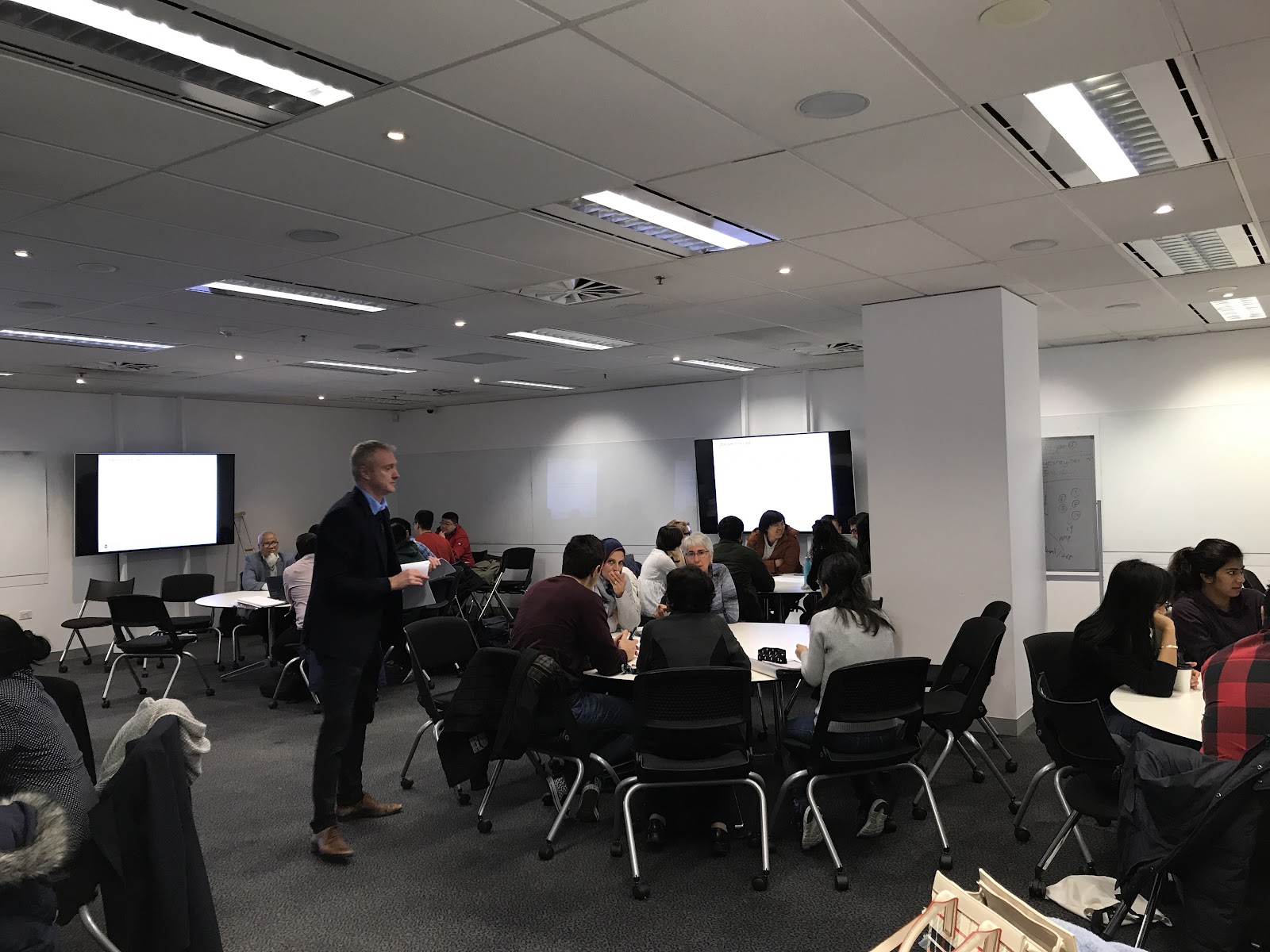
I visited Caulfield's STARLab (Simulated Teaching and Research Laboratories) to observe the BFX5260 Treasury and Financial Markets teaching team in action, and I was in for a treat. The morning started out with great energy. Students were lining up to get their ID card scanned for attendance, and looking eager to get started.
This semester, the BFX5260 teaching team have implemented co-teaching, the flipped-class model, trading simulation, and digital in-class assessment all at once. How do they do it? Let’s dive in.
Co-teaching
Wayne Huf, Amale Scally, Simon Yap, Long Pham and Linh Nguyen make a great teaching team. They did a fantastic job collaborating to facilitate two classrooms simultaneously. One of the goals was to keep the two classes going at the same pace, and timing of in-class assessments to be in sync.
In order to achieve that, responsibilities are shared among the teaching team. Everyone takes turn to instruct, facilitate activities and provide technical support to students every week.
The co-teaching model got everyone in the team on their feet, and actively attending to every group in the class. It was great to see how much attention and support students received throughout the session.

Wayne Huf, Amale Scally, Simon Yap, Long Pham and Linh Nguyen make a great teaching team. They did a fantastic job collaborating to facilitate two classrooms simultaneously. One of the goals was to keep the two classes going at the same pace, and timing of in-class assessments to be in sync.
The co-teaching model got everyone in the team on their feet, and actively attending to every group in the class. It was great to see how much attention and support students received throughout the session.
Flipped-classroom model
The concept of a flipped-classroom model has been around for some time, and has earned its place in the current landscape of higher education. Exploration and familiarisation with the new weekly topic happens prior to class time, and that's what has been implemented in BFX5260.
'Pre-load' materials including short videos, reading and exercise files have been provided for students to engage in independent learning every week. Moodle resources were referenced frequently during the session, which was a fantastic way to reemphasise the significance of the Moodle site as a one-stop-shop to assist students with their study. Workshop times are dedicated to hands-on activities and peer-learning where students exchange ideas and consolidate new knowledge. What's more, is that students are incentivised to complete pre-class work by a weekly test at the beginning of class. Even though questions are randomised, students were allowed to discuss and work collaboratively through this assessment.
'Pre-load' materials including short videos, reading and exercise files have been provided for students to engage in independent learning every week. Moodle resources were referenced frequently during the session, which was a fantastic way to reemphasise the significance of the Moodle site as a one-stop-shop to assist students with their study. Workshop times are dedicated to hands-on activities and peer-learning where students exchange ideas and consolidate new knowledge. What's more, is that students are incentivised to complete pre-class work by a weekly test at the beginning of class. Even though questions are randomised, students were allowed to discuss and work collaboratively through this assessment.
An important note to take here is that the link between pre-class and in-class work has been well illustrated. Without having done their work prior to coming to the session, students' learning experience would not have received the same benefits and impact.
 |
| Excel classes were offered to students to help them become more confident with using the software |
Trading simulations
Throughout the session, students went through a range of simulated trading scenarios. Pre-programmed prompts were scheduled during some of the activities to increase interactiveness and sophistication of the exercise. This was a fantastic illustration of how complex and fast-paced a real trading environment could be.

The design of these workshops has thoughtfully taken into account valuable opportunities for students to apply what they have learned, and go from knowing to doing. What's more, is that students go to practice making decisions promptly and effectively, to respond to the dynamic nature of their future employment context.

The design of these workshops has thoughtfully taken into account valuable opportunities for students to apply what they have learned, and go from knowing to doing. What's more, is that students go to practice making decisions promptly and effectively, to respond to the dynamic nature of their future employment context.
To guide students through these simulations, procedural knowledge was demonstrated on Excel by the facilitator, followed by time for repetition on students' computer.
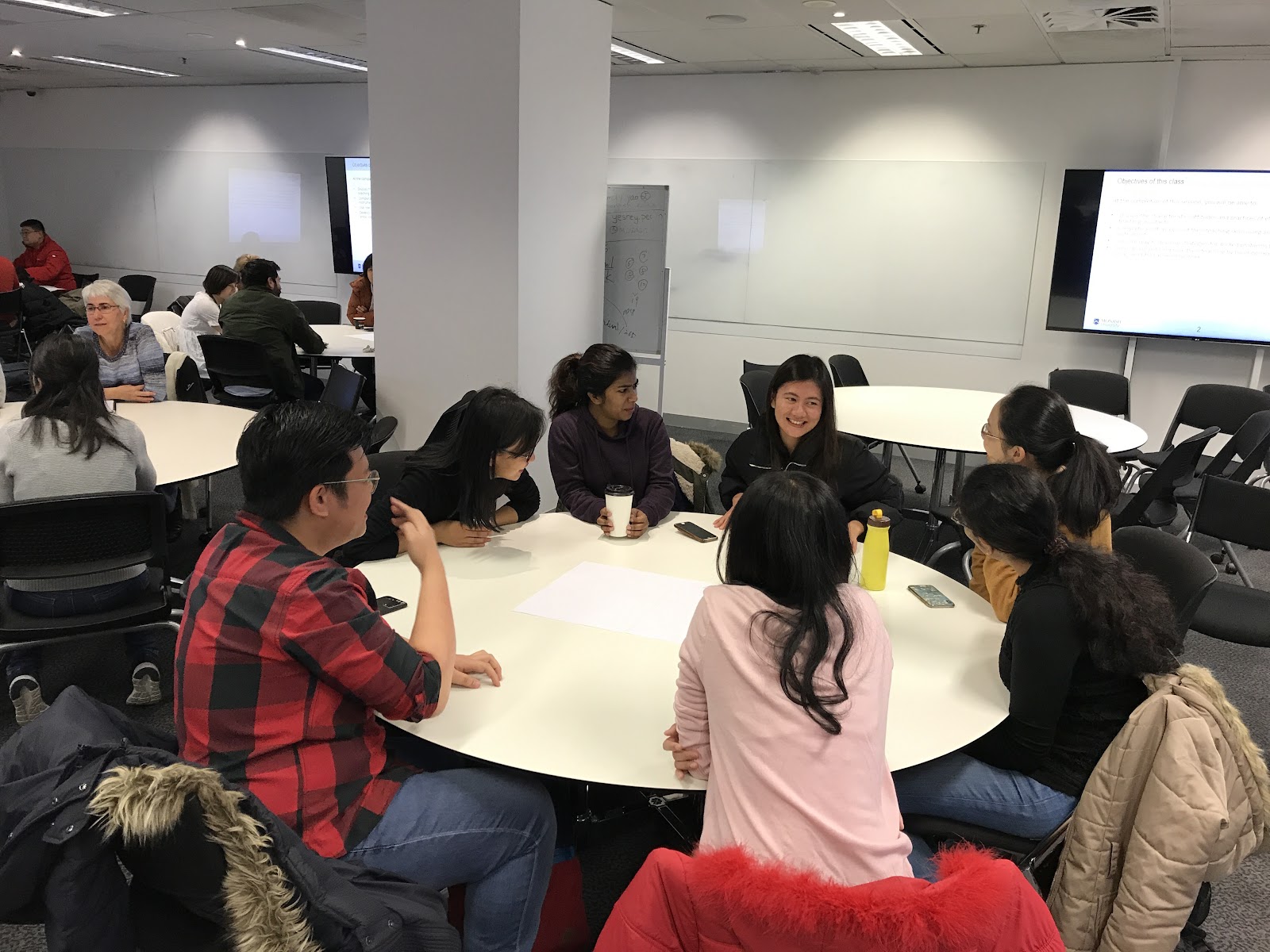
Learning is then solidified by peer learning. The trading simulations happened as individual exercises as well as group activities. Conversations were buzzing among students in the room to discuss the process and results of their practice.
 |
| Students working on their Excel sheet |
Learning is then solidified by peer learning. The trading simulations happened as individual exercises as well as group activities. Conversations were buzzing among students in the room to discuss the process and results of their practice.
 |
| Students discussed during the exercises |
By closely watching and assisting students while the simulations occurred, the facilitator was able to recognise and showcase outstanding work from individual student for the whole class. The students were also rewarded with very encouraging comments from the instructor and their peers, adding even more energy to the atmosphere.
In-class assessment
In-class assessment was conducted at the end to solidify everything new students have learned throughout the session. To ensure the integrity and authenticity of students' attempt during the assessment, a software called AB Tutor was run in the control room. Excel files containing students' work were pulled from their Monash computer and deleted once the transfer has been completed.
 |
| The control room - where the "magic" happens |
The vision
The learning activities in STARLab do not only provide an opportunity for students to gain simulated trading experience, but also expose students to ethic considerations, encourage them to be professional and understand the value of their human inputs behind machines. Click the video below to hear from the teaching team and a unit alumnus themselves.
A closing thought
It was inspiring to see the amount of thought and effort that went into designing and delivering the unit. Perhaps it took trial-and-error to continuously improving their teaching practice, but the team have been rewarded with the level of participation and engagement among students.
We look forward to observing more active learning strategies in your classroom.

We look forward to observing more active learning strategies in your classroom.